You’ve been here before. The stakes are high. You’re sitting across from a colleague, a partner, or a team member — and the conversation ahead is one you’d rather avoid. Not because you’re afraid of conflict, but because you understand its cost: time, energy, and trust.
The truth is, it’s not hard to pinpoint the issue. What’s hard is knowing how to say what needs to be said — in a way that gets heard, not resisted.
Here’s the shift:
Handling difficult conversations isn’t about having the right script. It’s about setting the right tone.
One of the most effective — and most overlooked — strategies is this:
- Listen actively.
- Speak clearly.
- Use “I” statements.
It sounds simple. But done well, this approach transforms tension into progress. It creates space for clarity, accountability, and forward motion — without collateral damage. And that’s not just a communication skill.
That’s leadership presence in action.
The psychology of difficult conversations
Difficult conversations rarely derail because of what’s being discussed. They derail because of how it’s being heard.
Here’s what typically goes wrong:
- Fear steps in — fear of being misunderstood or losing control.
- Defensiveness takes over — the conversation turns into a game of blame or justification.
- Clarity disappears — the message gets lost in emotion, tone, or timing.
When managers avoid these conversations altogether — or mishandle them — the cost compounds.
- Delayed feedback becomes disengagement.
- Misalignment turns into mistrust.
- Small cracks widen into culture issues.
But what if there’s another way?
Instead of forcing a difficult conversation, you could lower the heat and raise the clarity — all by changing your posture.
Because sometimes, the most powerful move isn’t about saying more. It’s about listening better, and setting the right tone.
That’s where active listening and “I” statements come in — not as soft skills, but as strategic tools for leaders who know that how you say it is the message.
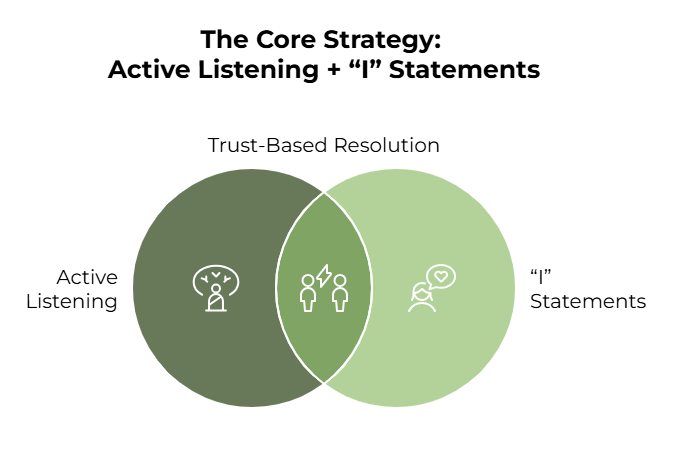
The core strategy: active listening + “I” statements
What is active listening?
In leadership, listening isn’t passive. It’s presence.
Active listening means showing up — fully — to hear what’s said, and what’s underneath it. It’s about giving someone your full attention, not just waiting for your turn to talk.
Cues matter here.
- Maintain eye contact, without overpowering.
- Nod occasionally — not to agree, but to acknowledge.
- Use open-ended prompts like:
“Tell me more.”
“What’s the real challenge here for you?”
“How does this impact your work?”
These are not tactics to manage the other person — they’re cues to signal safety. Because when someone feels seen, they’re more willing to collaborate, not defend.
“I” vs. “You” statements
Words shape emotional posture.
Compare:
- “You’re always missing deadlines.”
- “I feel stressed when deadlines are missed because it affects the entire team’s momentum.”
The first provokes. The second reveals.
“You” statements corner people. They imply blame, even if unintended.
“I” statements take ownership. They articulate your experience without assigning motive.
That subtle shift changes how the message lands — and whether the other person leans in or shuts down.
Why this combo works
Active listening builds the bridge. “I” statements walk across it. Together, they reduce defensiveness, deepen understanding, and open a pathway to resolution — without power plays, emotional withdrawal, or sugarcoating.
In high-stakes conversations, this is how you lower resistance and raise clarity. Not with force. But with presence and intentionality.
Many managers default to being “nice” rather than clear — but that often creates confusion, not trust.
Read more about why clarity beats kindness in leadership in our related article: The mistake managers make.
How to apply the strategy step by step

This strategy isn’t theoretical — it’s applied. And like most leadership tools, it’s less about complexity, more about consistency.
Here’s how to put it into practice:
1. Prepare with purpose
Don’t wing difficult conversations. Clarity starts before the conversation begins.
- Define your goal: What do you actually want to achieve from having this conversation?
- Identify your intent: Are you here to confront, or to align?
- Anticipate reactions: Where might emotions be triggered — in them, or in you?
This isn’t about scripting every line. It’s about entering with presence and self-awareness.
2. Start with empathy
Set the tone early.
“I know this may not be easy to talk about — but I want us to move through it together.”
This disarms resistance. It shows respect. And it invites partnership instead of polarization.
Empathy doesn’t weaken your authority. It strengthens your credibility.
3. Listen first
Let them speak — uninterrupted. Hold the silence. Be comfortable in it. Reflect what you hear. Clarify, don’t correct.
- “So what I’m hearing is…”
- “It sounds like this has been building for a while.”
This isn’t about agreeing. It’s about understanding — and signaling that they’ve been understood.
4. Share with “I” Statements
Once you’ve truly heard them, it’s your turn to speak. Use calm, direct “I” statements that focus on the impact — not the accusation.
“I’ve noticed the delays are creating a bottleneck, and I’m concerned about the impact on the broader team.”
“I feel frustrated when the priorities shift without notice — it makes it hard to allocate resources effectively.”
No blame. Just clarity. And emotional ownership.
5. Stay solution-focused
Don’t let the conversation end with venting. Move toward alignment.
“What do you think would help prevent this going forward?”
“How can we ensure we’re both set up for success here?”
Invite co-ownership of the resolution. This builds accountability without forcing compliance.
If you want practical frameworks to help you navigate these moments with confidence, explore our Management Tone Program. It’s built for c-level executives and managers who want to master the emotional tone of leadership — and handle tough conversations with clarity, not compromise.
If you like what you are reading, sign up to our newsletter. 1 email/month, no fluff.
Example scenario:
The situation
A Head of Product and a COO are in a recurring standstill. Deadlines are slipping. Tension is rising. The Product lead feels pressured, the COO feels blind sided — and every conversation seems to escalate instead of resolve.
They finally meet to “clear the air.”
Old pattern:
COO: “You never hit the timelines you commit to.”
Product Lead: “That’s because you keep changing the priorities last minute.”
Blame. Defensiveness. Gridlock.
New Pattern — Using active listening + “I” statements:
COO: “I want us to find a rhythm that supports both speed and stability. Can I get your perspective on what’s been getting in the way?”
(Product Lead explains delays, resource gaps, and shifting directives)
COO (listens, then reflects): “So the late pivots are creating rework, which makes it hard to hit deadlines. That makes sense.”
COO (pauses, then adds): “I’ve felt frustrated when timelines aren’t met, because it puts strain on the rest of the ops team. But I hear you — and I want us to solve this together.”
Product Lead: “Appreciate that. I think if we locked priorities at the start of the sprint, we’d gain back consistency.”
The shift
This isn’t about agreeing on everything. It’s about moving from friction to alignment.
When both parties feel heard, they don’t just defend their side — they start building the same side.
Common pitfalls to avoid
Even the most intentional leaders can fall into traps during high-stakes conversations. Awareness is your edge.
1. Interrupting — or preloading your rebuttal
If you’re planning your next point while they’re still talking, you’re not listening — you’re waiting.
Real listening requires a pause. Let them land. Then respond.
2. Emotional hijacking
When emotion spikes, clarity drops.
If you feel reactive — take a beat. Breathe. Re-anchor in your intent. Respond from presence, not pressure.
3. Misusing “I” statements
“I feel like you’re always late” is not an “I” statement — it’s a veiled accusation.
Use “I” to share your experience, not to disguise blame.
✅ “I feel anxious when meetings start late — it affects how we show up to clients.”
❌ “I feel like you don’t respect my time.”
Subtle, but critical.
4. Over-preparing to the point of rigidity
Structure helps. Scripts hurt.
If you’re clinging too tightly to your notes, you risk missing the actual conversation that’s unfolding. Be guided by your prep — not bound by it. The goal of this strategy isn’t control — it’s clarity. And clarity doesn’t come from talking more. It comes from listening better, speaking honestly, and leading the tone of the room.
Tips + resources
Even with the right strategy, delivery matters. Here are five common conversational missteps — and what to do instead.
Tip 1 — Don’t say: “You always…” or “You never…”
Avoid vague generalisations. They trigger defensiveness and shut down dialogue.
✅ Instead: Name the specific moment.
“In this morning’s meeting, I noticed you interrupted twice before the speaker finished.”
Focus on observable behavior, not character.
Tip 2 — Don’t say: “Calm down.”
Don’t escalate the moment. It’s dismissive and often heightenes emotion.
✅ Instead: Hold space.
“Let’s pause — I want us to have a clear conversation, not a reactive one.”
Model the tone you want.
Tip 3 — Don’t say: “I don’t have time for this.”
Don’t signal that the issue (or person) isn’t important.
✅ Instead: Show intentionality.
“Let’s set aside 15 minutes to talk through this — it matters.”
Presence > performance under pressure.
Tip 4 — Don’t say: “We need to talk.”
Don’t open with tension. It creates anxiety before the conversation even starts.
✅ Instead: Set the context.
“I’d like to check in about something that’s been impacting our team dynamic.”
Start with shared purpose.
Tip 5 — Don’t say: “This isn’t a big deal…”
Don’t downplay the issue. If it’s worth raising, it’s worth raising properly.
✅ Instead: Be transparent.
“This feels small now — but left unaddressed, it impacts how we work together.”
Lead with clarity, not comfort.
Practical reminders
- DO: Keep a calm, composed tone — especially when the room heats up.
- DON’T: Rush closure. Space allows clarity to land.
- DO: Stay grounded in facts and intent.
- DON’T: Default to hierarchy — this is about mutual understanding, not power.
Further readings & resources
For deeper guidance on managing hard conversations, explore these trusted sources:
- Indeed: 13 Tips for Handling Difficult Conversations Effectively
- Chartered Management Institute: Handling Difficult Conversations
- The challenges of senior management
- Staying ahead in c-suit roles means mastering professional development
Conclusion
Difficult conversations are inevitable. But drama? That’s optional.
When you lead with active listening and speak from ownership — using “I” statements — you reduce friction, build trust, and create space for real alignment.
It’s not about being soft. It’s about being strategic.
So next time the stakes feel high and the room gets quiet, pause. listen. lead the tone.
Clarity isn’t just what you say, it’s how you show up to say it.
FAQ
What is the best opening for a difficult conversation?
Avoid triggering phrases like “We need to talk.” They create anxiety before the conversation even begins.
Instead, open with clarity and purpose:
“I’d like to check in about something that’s been impacting our team dynamic — I think it’s worth us aligning on.”
Set the context, lower the emotional temperature, and invite shared ownership from the start.
How do I stay calm in a difficult conversation?
Presence beats preparation under pressure.
Pause before responding. Breathe.
Anchor in your intent. What outcome are you looking for?
Speak slowly, not passively. Clarity doesn’t need volume to land.
What should I never do in a difficult conversation?
Never use generalisations, threats, or avoid responsibility.
❌ “You always mess this up.”
❌ “This better not happen again.”
❌ “This isn’t my problem.”
These responses escalate tension and shut down dialogue. Instead, focus on observable behavior, not assumptions.
How do I deal with a boss that doesn’t communicate well?
Start by modelling what you want to receive.
Ask direct, respectful questions:
“What’s your priority here?”
“What’s the best way for me to stay aligned with your expectations?”
If clarity remains elusive, document key points after meetings or decisions.
Share summaries, request feedback.
How do I know when to walk away from the conversation?
When the conversation stops being productive — and starts becoming personal.
Say:
“I want us to have this conversation well, not just quickly. Let’s take a break and revisit when we’re clearer.”
Leadership is about timing as much as tone. Know when to lean in — and when to create space.